Tarwi vs. Lupini Beans: They’re Related, but They’re Not the Same Bean
If you’ve seen tarwi and thought, wait, aren’t those just lupini beans? Close, but no.
They belong to the same lupin family, and they even share that pale, round-ish appearance once prepared. But tarwi and the lupini beans you might find brined in a jar at an Italian market are different species with different histories, nutritional profiles, and ways of showing up on the plate.
What Is Tarwi?
In Peru, Ecuador, and Bolivia, tarwi isn’t some newly discovered ingredient. It’s a long-cultivated Andean crop known locally as chocho. Botanically, it’s Lupinus mutabilis, which explains why English-language research often refers to it as Andean lupin.
It has been part of Andean agriculture for well over a thousand years, traditionally eaten alongside crops like quinoa, maize, and potatoes.
And then there are lupini beans.
What Is Tarwi?
In Peru, Ecuador, and Bolivia, tarwi isn’t some newly discovered ingredient. It’s a long-cultivated Andean crop known locally as chocho. Botanically, it’s Lupinus mutabilis, which explains why English-language research often refers to it as Andean lupin.
It has been part of Andean agriculture for well over a thousand years, traditionally eaten alongside crops like quinoa, maize, and potatoes.
And then there are lupini beans.
So, What Are Lupini Beans?
“Lupini bean” can be a slightly confusing name because lupin refers to an entire genus of plants, not one specific bean.
The lupini beans commonly sold in Italian and Portuguese markets are typically Lupinus albus, or white lupin. That species has Mediterranean roots.
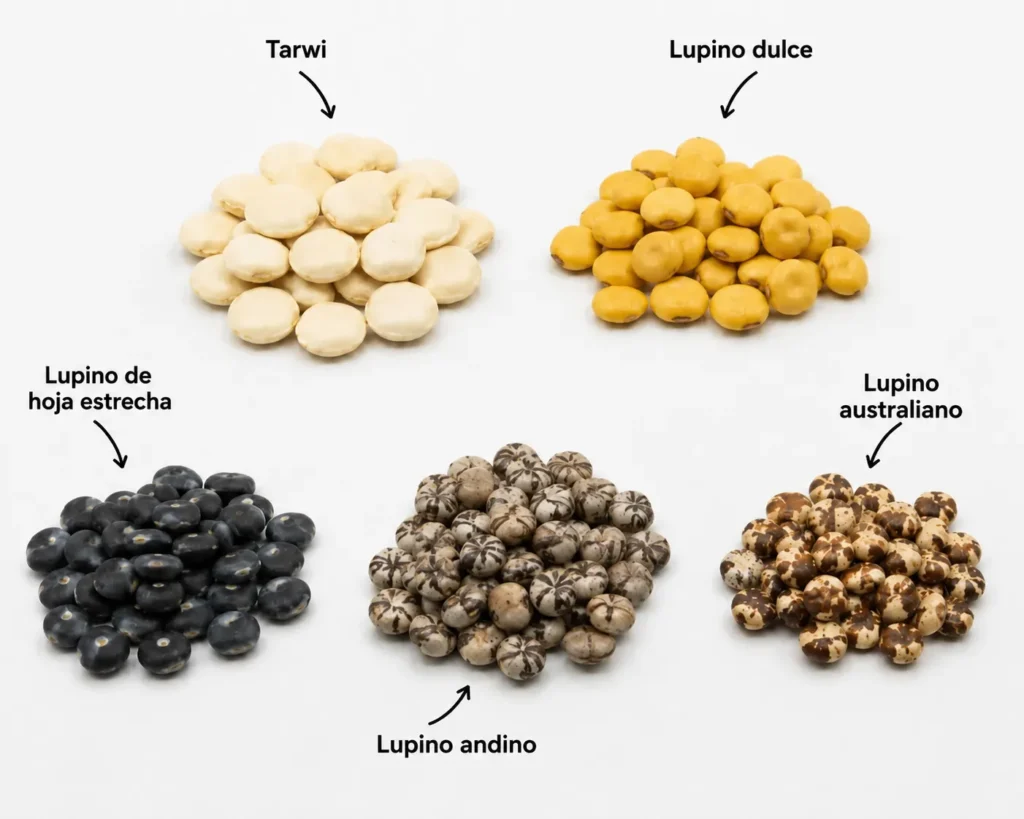
Tarwi, meanwhile, is Lupinus mutabilis, domesticated in South America. Same botanical neighborhood. Different address.
Tarwi vs. Lupini Beans: The Quick Comparison
The biggest nutritional distinction isn’t that one contains protein and the other doesn’t. Both are protein-dense legumes with very little starch. Tarwi tends to carry more protein and more fat by dry weight than Mediterranean white lupin.
Tarwi Pulls Ahead on Protein
This is where tarwi really shines.
Published figures put tarwi at roughly 40–50% protein by dry weight, although the exact amount varies by variety and growing conditions. Some ecotypes have measured above 50%.
That puts tarwi in a very different nutritional conversation from beans like chickpeas or lentils. But the important comparison here is with its closest relatives.
Tarwi generally contains more protein and fat than Mediterranean lupin species. That extra fat also changes the eating experience a little; the main tarwi guide describes it as adding to a richer mouthfeel.
In other words, these aren’t two names slapped onto the same nutrition label.
Tarwi Pulls Ahead on Protein
This is where tarwi really shines.
Published figures put tarwi at roughly 40–50% protein by dry weight, although the exact amount varies by variety and growing conditions. Some ecotypes have measured above 50%.
That puts tarwi in a very different nutritional conversation from beans like chickpeas or lentils. But the important comparison here is with its closest relatives.
Tarwi generally contains more protein and fat than Mediterranean lupin species. That extra fat also changes the eating experience a little; the main tarwi guide describes it as adding to a richer mouthfeel.
In other words, these aren’t two names slapped onto the same nutrition label.
They Have Different Roots, Too
Lupini beans have a long history around the Mediterranean.
Tarwi’s story happened thousands of miles away.
High in the Andes, tarwi earned its place for a practical reason: it could handle the altitude. And farmers weren’t only interested in what they could harvest. Tarwi fixes nitrogen in the soil, making it a useful crop to grow alongside rotations of potatoes and cereals.
That history matters because calling tarwi simply another lupini bean erases quite a bit of what makes the ingredient, well, tarwi.
One Thing They Definitely Have in Common: Bitterness
Here is where the family resemblance becomes much more obvious.
Both tarwi and lupini beans naturally contain quinolizidine alkaloids, compounds that make untreated beans intensely bitter and that need to be removed before the beans are eaten.
Tarwi traditionally goes through a multi-day debittering process involving soaking, boiling, rinsing, and repeated water changes. Heat by itself isn’t enough because the alkaloids are water-soluble but heat-stable.
So raw, untreated tarwi is not something to toss into a pot like a bag of lentils and hope for the best.
Properly prepared commercial tarwi has already gone through the necessary processing. If you’re buying raw seeds, that’s a different situation, and the full guide to tarwi explains the debittering and safety factors in much more detail.
One Thing They Definitely Have in Common: Bitterness
Here is where the family resemblance becomes much more obvious.
Both tarwi and lupini beans naturally contain quinolizidine alkaloids, compounds that make untreated beans intensely bitter and that need to be removed before the beans are eaten.
Tarwi traditionally goes through a multi-day debittering process involving soaking, boiling, rinsing, and repeated water changes. Heat by itself isn’t enough because the alkaloids are water-soluble but heat-stable.
So raw, untreated tarwi is not something to toss into a pot like a bag of lentils and hope for the best.
Properly prepared commercial tarwi has already gone through the necessary processing. If you’re buying raw seeds, that’s a different situation, and the full guide to tarwi explains the debittering and safety factors in much more detail.
Do Tarwi and Lupini Beans Taste the Same?
Not quite.
Prepared tarwi has a firm, almost crunchy bite with a mild, nutty and faintly savory flavor.
Unlike softer beans, it keeps its shape particularly well in liquid.
That makes it useful anywhere you actually want to notice the bean rather than have it disappear into the dish.
Traditionally, tarwi shows up in preparations like Ecuadorian ceviche de chocho, where the beans are paired with red onion, tomato, lime and cilantro. It can also be added to soups, salads and grain bowls or eaten toasted as a snack.
Lupini beans will feel familiar if you’ve eaten them straight from a jar as a salty, brined snack.
The experience overlaps, but they’re not automatically interchangeable in every recipe.
Which One Should You Choose?
If you already eat lupini beans, tarwi probably won’t feel completely foreign. There’s enough family resemblance to understand the comparison.
But tarwi brings its own nutritional profile, Andean history, and culinary traditions to the table. It isn’t a new version of lupini beans, and it isn’t a rebrand of something that was already sitting in the Italian-food aisle.
It’s Lupinus mutabilis, a separate species that’s been part of Andean food culture for centuries and is only now becoming more visible outside South America.
And if this is the first time you’ve heard of it, start with our complete guide to tarwi. There’s quite a bit more to this little bean than its resemblance to lupini.
×
Thank you for your interest in Tarwi!
We’ve received your information, and a member of our team will be in touch to learn more about your needs and discuss how Tarwi could work for your business.